Davood Gozli

RESEARCH & WRITING

Menu
  • Home
  • YouTube
  • Reading Group
  • Substack
  • Publications
  • Bio
Menu

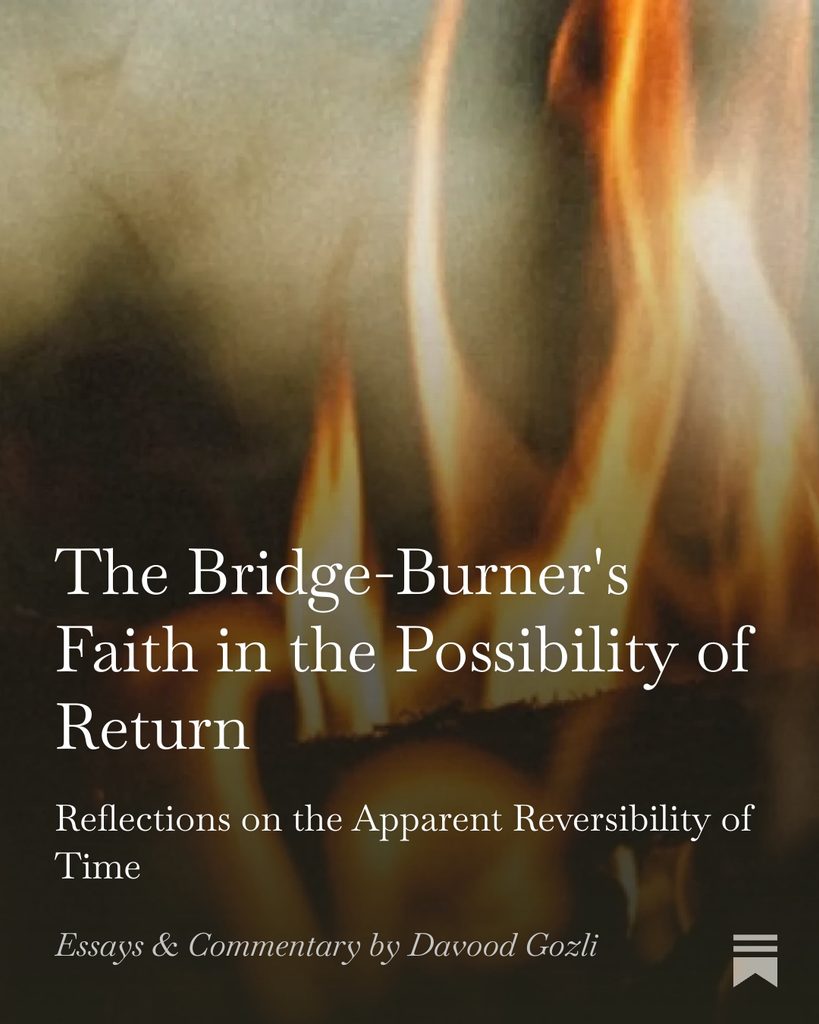
The Bridge-Burner’s Faith in the Possibility of Return

Posted on 03/09/202603/09/2026 by Davood Gozli
Reflections on the Apparent Reversibility of Time

My favourite high school teacher, Mr. Javid, taught us precalculus in junior year and calculus in senior year. I had never before seen such an intense and attentive teacher. There was a sense of precision in the way he spoke, in the way he moved across the classroom, and in the way he kept the class in a state of alertness by calling on students at random to answer a question or finish his thought.

I can still remember, vividly, the first time I saw him walk into the classroom. We were immediately struck by his … charisma? It wasn’t so much charisma as his unusual form of attention. His attention seemed to come through (indeed, break through) a shield set by his irritability. Sometimes when he spoke, it was as though someone was breaking a vow of silence out of pure rage. But despite that, he paid attention. How was it possible that despite being so irritable, and irritated to near-maximum capacity, he was capable of such intense attention?

Mr. Javid’s aura, his particular form of charisma, was wrapped in the smell of cigarettes, which he chain-smoked before and after class. (How much of his growing irritability during the class was due to nicotine withdrawal, and how much of it was because of spending time and interacting with us?) Once, he told us his wife had been worrying about him because he was smoking more while grading our exams. Did he want to be, to borrow Susan Sontag’s phrase, an exemplary sufferer? A tragic teacher? Was he suffering for the sins of his students?

The coexistence of passion and methodicity in a single person is rare, because being methodical tends to calm passion. When passion is channelled and transformed into method, with little remaining beyond its cold, impersonal application, the person begins to seem uninteresting from the outside. This is partly why many academics, including many teachers, despite having dedicated their lives to a subject or a question, can bore people to death when talking about their work.

In Mr. Javid’s case, his work, his method of being a teacher, could not fully contain his passion. There was a visible excess, a passion that exceeded his careful steps and hard work. This excess of passion, its Nietzschean proof, was perhaps also the ground of his irritability, of his tendency to criticize students constantly. It was as though his excessive passion wanted to be captured, channelled, calmed, to be reasoned into calmness: “I want to be calm, and I would be, if only you all did your part, if only you gave me sufficient reason to be calm.”

Is this visible passion a failure of sublimation, or does it reveal an ambivalence toward total sublimation? Either way, the result appears to be a passion doubtful of its own justification, a passion seeking confirmation of its cause, a passion looking to be assimilated while remaining resistant, a homeless passion.

Read the full essay on Substack.

Leave a Reply Cancel reply

Your email address will not be published. Required fields are marked *

This site uses Akismet to reduce spam. Learn how your comment data is processed.

Search

Archives

©2026 Davood Gozli